
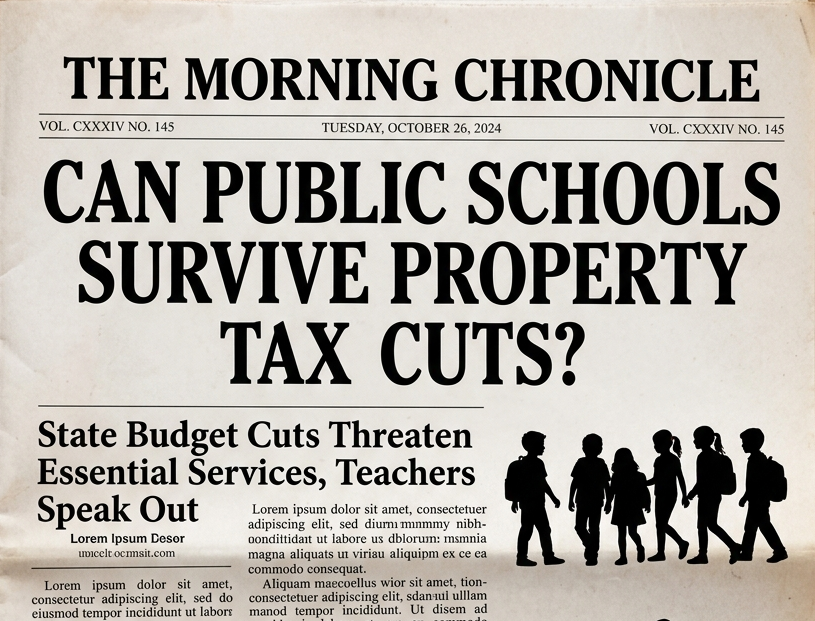
Property tax reform could have profound impacts on public school districts, the real estate market, and the broader economy.
(This article was originally published on my Substack newsletter at: https://owenerichasoniv.substack.com/p/can-public-schools-survive-property)
Florida is at the epicenter of a bold experiment, but it’s not the only state pushing to reduce or eliminate property taxes for homesteaded houses. For instance, Georgia lawmakers in 2026 advanced major property tax reforms, including SB 33 and HB 1116, which would cap annual assessment increases at the lesser of 3% or inflation—giving homeowners greater stability as values rise.
Texas has moved aggressively to curb property tax growth by raising the homestead exemption to $100,000 and restricting how quickly cities and counties can increase tax revenue without voter approval. Meanwhile, Ohio lawmakers have introduced property tax relief proposals that expand exemptions and limit reassessment-driven increases. And, despite Indiana’s circuit breaker caps limiting primary residence taxes to 1% of assessed value, rising home prices still drive higher bills. Lawmakers are exploring assessment adjustments and targeted relief for the hardest-hit homeowners.
Furthermore, Kansas has focused on restraining the growth of property taxes rather than eliminating them. Nebraska homeowners face some of the nation’s highest property tax burdens, with effective rates of 1.5%–1.7%. Rising farmland and home values have intensified the pressure, prompting lawmakers to propose reducing reliance on property taxes by boosting state school funding and expanding consumption-based revenue.
But where the push is most evident is in the Sunshine State. Naturally, there’s opposition, which routinely raises concerns about funding cuts to law enforcement, fire services, emergency medical services, education and public schools, infrastructure, and natural resource projects. But all of those are exempt. Nevertheless, those against property tax relief repeatedly warn these and more services will be cut, with emphasis on schools. However, what opponents usually leave out is the actual state of the public school system. And in Florida, the numbers are shocking.
As More People Move Into Florida, Public School Enrollment Continues to Drop
Florida’s public schools have lost about 55,000 students since the 2019–2020 school year. By the 2023–2024 academic year, at least half of the state’s 3.7 million K–12 students, estimated at approximately 1.8 million, had left public schools for private, charter, magnet, or homeschooling, according to an Orlando Shine August 2025 news report.
Additionally, current state forecasts and reports indicate that traditional public school enrollment remains significantly below pre-pandemic levels and is projected to decline further in the coming years, according to the South Florida Sun Sentinel. This, even though Florida has a growing population, including couples with children.
Nearly simultaneously, property tax collection in the Sunshine State reached approximately $55 billion in 2024, up from $33.9 billion reported in 2019, an increase of 62.8 percent, the Pensacola News Journal reported earlier this year. In fact, from 2019 to 2023, homeowners across the peninsula experienced the largest rise in median annual property taxes in the country, rising 38 percent from $2,003 to $2,762.
The Booming Population, but Shrinking Public School Enrollment Paradox
Coinciding with rising property taxes is Florida’s cost of living, which has surged since 2020, with annual increases accelerating from 1.3 percent in the 2010s to roughly 5.8 percent annually in the 2020s, a near fivefold acceleration, according to a 2026 Florida TaxWatch analysis, with housing being the primary driver.
Yet, even amid rising costs of living, from 2020 to 2025, the Sunshine State recorded a net resident gain of 1.5 million to 1.8 million, according to the latest available data. However, the peninsula has also experienced substantial outflows, though it’s trailed states like New York, California, and Illinois in population loss. Those who have left Florida most often cite affordability as the primary reason. Regardless, millions more people now call Florida home; still, public school enrollment across the peninsula continues to shrink.
Given these factors and figures, property tax reform remains at the top of the legislative agenda, fueling an ongoing debate between lawmakers who want to substantially cut or eliminate property taxes and those who warn against such moves. Those in favor cite a state budget surplus and tourism dollars. But those against worry that such changes will hurt public school districts. So, what’s the most likely scenario if property taxes are reduced or eliminated?
Soaring Property Taxes and Surging School Budgets Set the Stage for Reform in Florida
As mentioned, Florida saw the largest rise in median annual property taxes in the U.S., rising about 38 percent between 2019 and 2023. Historical growth previously hovered around 5 percent annually. Still, this rate doubled to 11.17 percent in 2020. It averaged 10.3 percent annually during the decade’s second half, year over year, with major metropolitan areas experiencing some of the steepest jumps between 2019 and 2024.
These increases help to explain why there’s a growing movement among state legislators to reform property taxes. But they don’t tell the whole story. Proponents of property tax reform are not only driven by rising taxes, but also by questionable budgets. In the 2014–2015 school year, total funding reached about $18.9 billion, according to the Florida Department of Education’s Florida Education Finance Program (FEFP) calculation. By the 2024–2025 school year, that figure had risen to $28.4 billion, according to the FDOE Budget Summary. This represents an increase of roughly $9.5 billion, or approximately 50.3 percent in total annual funding over the decade, the Florida Policy Institute estimates.
Currently, public schools account for approximately 40 percent of the state’s total property tax revenue. But for homesteaded properties, that percentage rises to 55-60 percent. For non-homestead properties—which include commercial real estate, rental properties, and second homes—public school funding typically accounts for 35 percent to 40 percent of the total property tax bill.
As of early 2026, Florida school districts are receiving roughly $21.6 billion in property tax revenue. Although the millage rates themselves have remained relatively stable or even decreased slightly in some areas, the total dollar amount homeowners pay has risen due to significant increases in property valuations over the last few years.
The Critical Role of Homesteaded Properties in Public School Revenue
Currently, all property taxes, homesteaded and non-homesteaded, account for about 47 percent of total public school budgets. Approximately 49 to 50 percent comes from sales taxes, corporate income taxes, the Florida Lottery, Title I Funds, the Individuals with Disabilities Education Act, and the National School Lunch Program. (The remaining ~3 percent comes from impact fees, district cash reserve interest income, and donations and grants.)
Since homesteaded, owner-occupied properties account for about 55 to 60 percent of public school revenue, that same amount would have to be made up elsewhere. Proponents of property tax reduction or elimination would preserve non-homestead properties, which typically generate revenue for owners.
The Fiscal Debate of Replacing Revenue with Sales Tax and State Backfiling
But what happens if homesteaded, owner-occupied residences are no longer subject to property taxes? Critics, like the Florida Policy Institute, argue that this will defund schools, law enforcement, and first responders. However, school budgets have continued to increase, even as student enrollment has substantially decreased. Which begs the question: where is the money going? Should the sales tax be raised, that increase, in conjunction with state funds, would make up the difference. (Still, fiscal reform would be necessary after audits are conducted to streamline public school budgets.)
Critics also say property tax cuts only help owners, not renters. But that ignores basic business economics. Lower carry costs translate into more competitive rental rates. Market competition would also motivate property owners to make their leases more affordable.
Opponents of property tax reform also label sales taxes “regressive.” But these are consumption-based and choices, whereas property taxes are unavoidable. Furthermore, tourists don’t pay property taxes, but residents do, and residents also pay sales taxes.
Public schools can also count on state-level backfilling, as the state of Florida enjoys a healthy budget surplus and tourism dollars contributing to sales taxes, which can be used to fund the “Florida Education Finance Program” (FEFP) directly, replacing local property tax dollars with state-level consumption dollars.
What’s more, not all proposals seek deep property tax cuts or total elimination. Some proposals only eliminate the non-school portion of property taxes. Or, allow local voters to decide via referendum whether to maintain a small millage for specific school projects. This would allow communities to stay in control.
The Case for Reform Results in Economic Growth and Benefits Homeowners
First, proponents point out that no one truly owns property if they pay rent to the government through taxes. Also, homeowners have no control over rising property values. So, cutting or eliminating property taxes would benefit all homeowners, especially seniors and people on fixed incomes. Additionally, even a partial overhaul could provide timely relief, amounting to roughly $1,000 per homesteaded property.
Second, the “Save Our Homes” tax cap virtually disappears when owners sell and buy again, resetting their baselines to much higher levels, which can easily prohibit people from moving within the state even if they seek better employment opportunities.
Third, real estate professionals state that removing annual property tax liabilities would not only benefit homeowners but also homebuyers. This would further make the Sunshine State more attractive to investors and homeowners, potentially increasing the aggregate value of Florida’s housing stock by hundreds of billions of dollars. Plus, doing so would shift tax burdens onto non-Floridians, including the over 140 million annual tourists.
Also, transitioning away from property taxes to consumption taxes would necessitate discipline among local governments and school districts, compelling them to reduce bloat and waste driven by rising property taxes and encouraging them to be more responsible and leaner.
Owen E. Richason IV is the author of “S4: Students, Schools, Social Media, & Success” and “The College Merit Scholarship Appeal Guide”. Owen is also a writer for the St. Pete-Clearwater Sun and has contributed to The Houston Chronicle, San Francisco Gate, AOL, BAM Magazine, Boss Magazine, Tampa Bay Business Insider, and The Washington Examiner.
Leave a Reply