
California’s the exodus king? Florida’s public schools show stiff competition—and one district is panicking.
(This article was originally published on my Substack newsletter at: https://open.substack.com/pub/owenerichasoniv/p/this-quiet-exodus-shows-how-florida)
All across the internet, headlines abound about California’s diaspora. Residents are leaving in droves, mostly relocating to Texas, Arizona, Nevada, Washington, and, of course, Florida.
From 2024 to 2025, former California residents mostly chose the Lone Star State, with more than 45,000 moving in during 2024, followed closely by the Grand Canyon State and the Silver State, according to the San Francisco Gate, leaving the tarnished Golden State shrinking in size.
Another 39,000 relocated to the Sunshine State between 2023 and 2024. Now, the peninsula boasts approximately 23,462,518 residents, according to the U.S. Census Bureau. It has been ranked as the third-most populous state in the union, displacing New York since 2014. And it continues to gain additional residents to this very day. (Although the pace has significantly slowed since the pandemic era, welcoming approximately 972 new residents per day in 2024 and about 550 per day in 2025, according to the Florida Office of Economic and Demographic Research.)
Those transplants moved in large volume to Polk, Lee, Hillsborough, Broward, and Miami-Dade counties. Meanwhile, St. Johns and Osceola counties are among the fastest growing, with the City of Ocala ranked at the top of all U.S. cities in 2022, 2024, and 2025.
But between 2024 and 2025, Pinellas County actually lost a whopping 11,834 residents, according to the most recent U.S. Census Bureau data, ranking second among counties nationwide for the largest population decline. Only Los Angeles County saw a bigger drop, amid its own crisis from destructive wildfires, rising crime, high cost of living, and a decrease in quality of life.
However, local officials, Commissioner Brian Scott, and State Representative Linda Chaney, say that the county’s projected growth forecasts a 2 percent year-over-year increase over the next decade, and have attributed the decline to the 2024 hurricane season. Furthermore, other local officials rightly describe the dip as consistent with historical patterns following major hurricanes, because the area typically rebounds as conditions stabilize.
Still, Pinellas County remains the seventh-most populous of Florida’s 67 counties. It’s also the most dense. And, it’s been my home since 1971. I was born in St. Pete, “the home of the newly-wed and nearly dead,” a moniker given to it due to the influx of new residents during the 1950s and 1960s (the same period when my paternal grandparents arrived, who were transplants from New York). Also known as “God’s waiting room,” St. Petersburg was founded by a Russian immigrant who named it after his home city.
The City of Seminole, located in the west-central portion of Pinellas County, where my wife, my son, and I live now, was incorporated in November 1970, almost a year before I was born, and had a population of just 2,463 residents. At the time, the entire St. Pete-Clearwater area had approximately 522,329; today, the estimated population is nearly double, around 963,000, and there are approximately 3.46 million residents in the four-county Tampa Bay metro area (Hillsborough, Pinellas, Pasco, and Hernando).
Since Pinellas County is a small peninsula on a larger peninsula, land is naturally finite. So, like many other places, it’s growing vertically. Back in the 1970s, downtown St. Pete was nearly bare. Today, it’s a thriving city, with mixed-use buildings rising shoulder to shoulder, offering housing, workspaces, entertainment, shopping, dining, and plenty more. Its current crown jewel is the Residences at 400 Central, a luxury condominium tower that rises 515 feet over 46 stories. That’s a huge change, and new construction is continuing on several other commercial and residential projects even now. And because this is happening everywhere across the state, some schools are gaining more students, while others are losing students.
In the year I was born, 1971, the Pinellas County school district operated 116 school facilities and served 82,373 students. Today, that figure ranges from 144 to 162 public institutions, including over 75 elementary schools, 24 middle schools, 18 high schools, and more than 14 charter schools, making it one of the largest districts in the state of Florida and the single largest employer in Pinellas County.
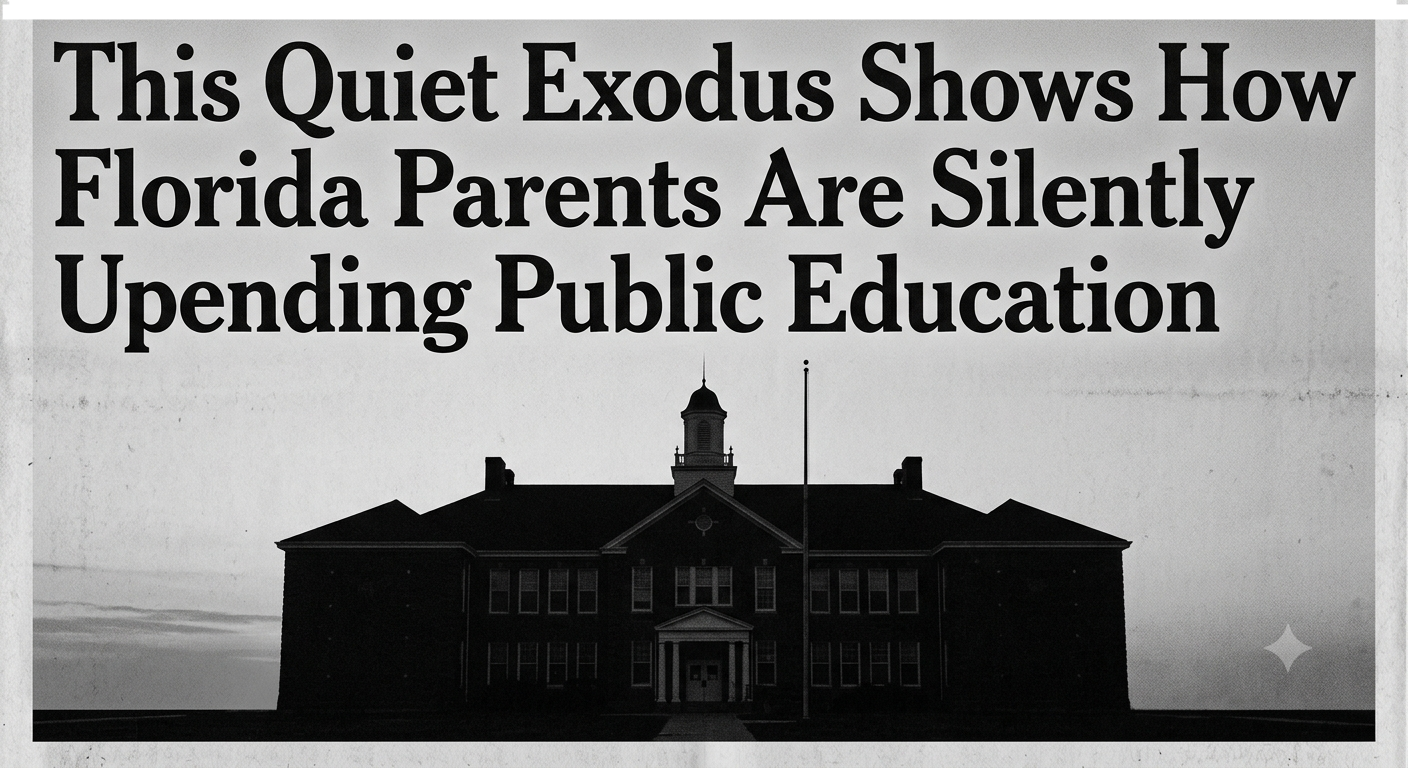
But, like California, the public school student population is shrinking. In fact, Pinellas County Schools (PCS) have reported a loss of almost 4,000 students in the 2025-2026 academic year. Kindergarten saw the largest decrease, with a 9 percent decline during the most recent enrollment cycle. But that does not tell the whole story.
The Florida Department of Education’s most recent enrollment audits reveal that PCS has lost approximately 6,654 students over the last three academic years, going from 90,875 students in 2023-2024 to 88,162 in 2024-2025 to 84,221 in 2025-2026. As a result, some public school campuses were left to operate at less than 50 percent capacity, WUSF reported.
During the same two-year period from 2023 to 2025, domestic outflows totaled 15,973 residents, according to the latest U.S. Census Bureau data and regional demographic reports.
Meanwhile, the same is happening in neighboring Hillsborough County, where its public school board just announced three campus closures for the 2026-2027 academic year (Graham Elementary, Madison Middle School, and Pizzo K-8).
Similarly, Pinellas County is shuttering Cross Bayou Elementary and Disston Academy, merging Bay Point Elementary and Bay Point Middle School, and converting Oldsmar Elementary into a K-8 facility to stabilize enrollment. And the county is using the latest U.S. Census Bureau data as cover.
Yes. It is true that Pinellas County suffered a net population loss between 2024 and 2025. But why?
Why would families leave a place that’s tax-friendly, full of employment opportunities, and boasts some of the best beaches, recreation, and weather in the entire country?
Well, PCS has an explanation, citing three reasons: a declining birth rate, rising housing costs, and demographic shifts, with many new residents being retirees rather than families with children. (Of course, there is also the effects of Hurricanes Helene and Milton, devastating back-to-back storms which unleashed widespread destruction in September and October 2024.)
No one can deny the impacts of such dynamics. The entire world is experiencing a decline in birth rates, including the West. Housing costs are rising in Pinellas County. Fewer families are moving in. And yes, Hurricanes Helene and Milton virtually wiped out entire neighborhoods. But those neighborhoods have been almost completely rebuilt, with a large percentage of locals remaining and a small number of new residents moving in.
Now, here is what the Pinellas County School Board is not telling anyone—the district has been losing students for many years, well before the 2024 hurricanes and 2020 pandemic. In fact, PCS has lost more than 11,000 students since the COVID-19 shutdown in 2020, according to the Florida Department of Education.
Beginning the very next year, in 2021, private schools in Pinellas County and homeschooling alike exploded in popularity, with enrollment skyrocketing at Indian Rocks Christian School (our son’s school), Keswick Christian, Calvary Christian, St. Pete Catholic (my wife’s alma mater), Northside Christian (where my sister-in-law teaches), Clearwater Central Catholic, Admiral Farragut Academy, and more.
All of these private schools in Pinellas County maintain long waiting lists, as families continue to try to get their children in. At IRCS alone, the waiting list runs into hundreds of eager applicants, and most of the other private schools in the area are experiencing the same.
Meanwhile, homeschooling has also been on a steep rise. Across Florida, the number of homeschooled students surged by 46 percent between the 2019-2020 and 2023-2024 school years. The Sunshine State has approximately 114,370 families and 152,871 students participating in home education, according to the most recent data (2024-2025). Moreover, Pinellas County remains one of the more active districts in this transition, with a dedicated Home Education Office to manage the high volume of “Notice of Intent” filings.
What is more, approximately 7,000 students in the county now attend charter schools, which offer publicly funded education with more flexible administrative structures. Unlike traditional public schools, charters are freed from many of the administrative regulations that govern public schools (such as district-mandated curricula or staffing rules). In exchange for this freedom, they are held to strict standards. If charters fail to meet the academic or financial goals outlined in their contract, the district can close them down. Additionally, charters are centered around specific curricula, such as STEM, Montessori, and the arts. Plus, the teachers and faculty are not unionized.
These drastic shifts are not new, either. Actually, the exodus from public schools in Pinellas County has been happening since 2006. From that year on, the county’s population grew for 13 years straight, peaking in 2019 at 975,367 residents. At the same time, as more families moved in, fewer students attended public schools. So, for about 20 years now, parents have opted to disenroll from the public school system in favor of private, charter, and homeschooling.
But again, why?
What would persuade and convince parents that their children will benefit from a private school, charter, or homeschooling? After all, private school tuition, fees, and costs are not cheap. Homeschooling requires at least one parent to stay at home. And charter schools are far more stringent in their coursework, with many not offering bus transportation, requiring parents to drive students to and from campuses.
Living here and experiencing the shift in real-time gives me a lot of insight. Plus, speaking with local parents, teachers, administrators, and law enforcement greatly helps to piece the puzzle together.
How Vouchers, Safety Concerns, and School Choice Are Reshaping Public Education in Pinellas County
Like many things in life, understanding such a complex system is not necessarily easy. For instance, when our two oldest nieces were in elementary school, they were enrolled at the same campus. That is, until the district decided they were not. Yep. You read that right. One year, that changed. My brother and sister-in-law were informed by PCS that their daughters were now zoned for two different campuses. The oldest could continue in the same school, but the youngest would have to attend a different school in the district.
My brother and sister-in-law protested the change, of course. They filled out forms, made several phone calls, sent emails, and met with people in person. But to no avail. Despite living in the same house, the sisters were now zoned for two different schools. Unable to rectify the situation, my sister-in-law opted to re-enter the workforce and put her teaching degree back to work—at a private school. (Where, eventually, their daughters would receive a free education, an enormous employee perk.)
But that is just one example among many. Parents in Pinellas County are pulling their children out of the local public school system for several reasons, and these are just three of them:
- First, PCS campuses have long had a reputation among locals and natives as unsafe. This is also not new. This perception, based on real-life incidents, has been around since the 1980s and 1990s. (In fact, this is precisely why my parents enrolled my brother and me into a private school in the early 1980s.) This is not entirely anecdotal, either. Parents cite concerns about the school environment, safety, and peer influences as the primary reasons. This is supported by a 2025 Pew Research study, which found that 83 percent of homeschooling parents were motivated by concerns over school safety and drugs.
- Second, it’s no secret among residents that the quality of education at private schools is much better than at public schools. This quality of service to the students is amply demonstrated by prospective public school students who must take entrance exams to get into private schools and routinely fail them.
- Third, parent involvement is noticeably higher at charter and private schools. Parents of charter and private schools regularly communicate with teachers and administrators regarding their children’s academics, socialization, and more, according to several experienced, local teachers and administrators.
But there is a lot more that explains why parents are pulling their children out of public schools and enrolling them in charters or private schools, or turning to homeschooling. And they are due to a combination of legislative changes, rising living costs, and a desire for more personalized educational environments.
In 2020, the COVID-19 pandemic led schools to shift to remote learning. As we all know, parents were exposed to what their children were “learning.” Following the reopenings, our school, IRCS, and my sister-in-law’s school, NCS, saw a substantial enrollment increase, along with practically every other private and charter school in the area.
Then, in 2023, parents were given more options when Florida’s Universal School Vouchers (HB1) expanded voucher eligibility to include all students regardless of household income. Unsurprisingly, voucher requests in Pinellas County nearly doubled, rising from 6,242 to 11,434, according to WUSF. This allows families to use state funds—approximately $8,000 per student—to pay for private school tuition or other educational services.
Meanwhile, homeschooling is another popular alternative to public schools because it not only gives parents direct control but is also often the best solution for families with students who require specialized therapies (such as those with autism or dyslexia). Homeschooling allows them to integrate occupational therapy into the school day.
National Numbers Don’t Lie
Obviously, the Pinellas County public school system is not the only district in the country to experience such student shrinkage. Parents nationwide are voting with their feet, pulling their children out of public schools and enrolling them in private, charter, or homeschooling programs. And it is no wonder why. The numbers tell the story better than any other explanation.
Only 35 percent of Americans reported being satisfied with the quality of K-12 education in the U.S., a significant drop from previous years and the lowest point in the 26-year history of this specific question, according to a September 2025 Gallup survey. The same poll found that roughly 73 percent of U.S. adults believe the K-12 system is headed in the “wrong direction.”
But it is certainly not the only one. A Fabrizio, Lee & Associates “Invest in Education” survey, conducted in January 2025, found:
- 75 percent of voters rated the U.S. public education system as “fair” or “poor.”
- By a nearly 2-to-1 margin, voters believe parents—rather than school boards or unions—should be in charge of deciding the best education for children.
- 74 percent of voters favored school choice policies that allow tax dollars to follow the student to public, private or technical schools.
These sentiments are shared across the country, even in the Sunshine State. Parents here and nationwide are taking action, realizing they do not need to run for city council, county commission, or the local school board to make a difference. They do not need to get intricately involved from the ugly inside to change the crazy system. All they have to do is make a simple choice. And when enough families do, public school districts panic. While those institutions might not make sweeping changes, they certainly cannot continue to operate unimpeded or without experiencing profound consequences.
So, yes, it is entirely possible for perturbed parents to passively upend stubborn public school systems. Because if parents do not participate, they no longer have to deal with perplexing, prolonged, and particularly unpleasant problems.
Owen E. Richason IV is the author of “S4: Students, Schools, Social Media, & Success” and “The College Merit Scholarship Appeal Guide”. Owen is also a writer for the St. Pete-Clearwater Sun and has contributed to The Houston Chronicle, San Francisco Gate, AOL, BAM Magazine, Boss Magazine, Tampa Bay Business Insider, and The Washington Examiner.
Leave a Reply